

When we speak about the birth of the digital age, the imagination often paints a picture of sunny California. But the truth is that the heart of the computer revolution began beating in the Texas heat. This wasn’t a “Hollywood” success story involving a garage and teenagers—it was a story of rigorous discipline, engineering stubbornness, and one hot summer in Dallas that echoed like thunder all the way to Houston.
Below, on houstoname.com, we examine the details of this epochal discovery:
- Why Jack Kilby’s lack of paid vacation became the luckiest break in the history of technology;
- How a single monolithic crystal of germanium solved the problem of miles of wires and millions of unreliable solder joints;
- The microchip’s role in the Apollo program and how NASA helped Texas monopolize space computing;
- An honest account of the rivalry with Robert Noyce and why Kilby didn’t become a scientific “rock star”;
- The philosophy of an inventor who was simply “solving a work task” and gave the world digital reality instead.
Solitude as an Engine of Progress
In July 1958, the hallways of Texas Instruments suddenly went empty. The company had an unusual rule for the time: practically the entire staff took a simultaneous two-week mass vacation. However, the silence in the laboratories was not absolute. Among the few who remained to work in the office, scorched by the Texas sun, was Jack Kilby—a tall, quiet engineer who had joined the team only a few months prior. Because he was a newcomer, he wasn’t yet entitled to paid time off. It was these two weeks of forced solitude in an empty lab that changed the course of technological history.
The “Tyranny of Numbers” — The Wall Humanity Hit
Before Kilby and the entire engineering community of the 1950s stood a fundamental problem dubbed the “tyranny of numbers.” Electronic devices of that era were becoming increasingly complex, but their reliability was plummeting.
- The Interconnection Problem. Any device consisted of thousands of individual components (resistors, capacitors, transistors), each of which had to be connected manually via soldering.
- The Human Factor. The more parts there were, the more solder points existed. It only took one loose connection for a massive device to turn into a heap of scrap metal.
- Size and Weight. Computers occupied entire rooms, not because their logic blocks were large, but because of the miles of wires connecting them.
While Kilby’s colleagues were vacationing, he tried to find a way out of this closed loop. His main task at TI was developing “micromodules”—an attempt to standardize part sizes to make them easier to assemble. But Kilby realized this was merely “cosmetic surgery” on an aging system.
A Bold Idea
The young engineer arrived at a conclusion that seemed almost absurd at the time: if all components of an electrical circuit could be made from the same semiconductor material, then there would be no need to separate them at all.
- The Monolithic Concept. Kilby decided to try placing all elements—both active (transistors) and passive (resistors and capacitors)—directly on a single semiconductor wafer.
- Ditching the Wires. Instead of soldering wires between parts, he proposed creating connections directly inside or on the surface of that wafer.
- The Scale Effect. This meant that the size of a device now depended not on the number of wires, but only on the size of the crystal itself.
The Moment of Truth
The Texas engineer immediately set out to realize his vision. Over several weeks, he prepared what would later be called the “most important invention of the 20th century.”
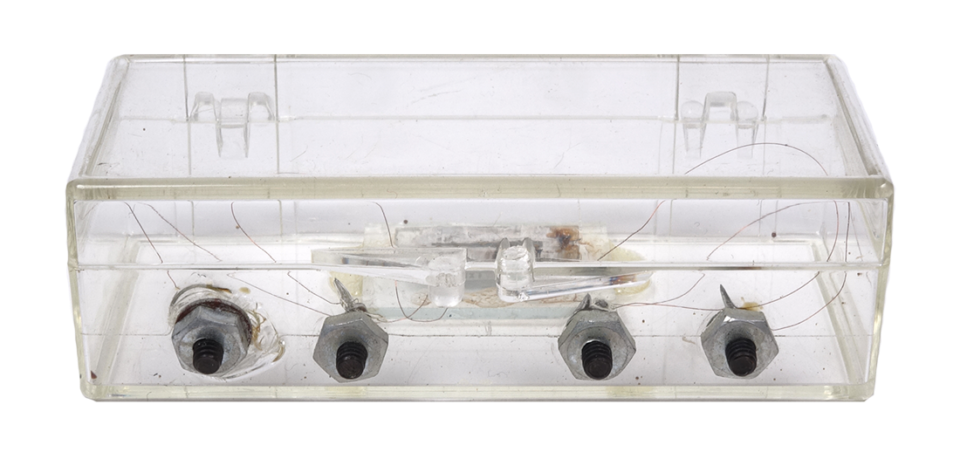
On September 12, 1958, Jack Kilby gathered the management of Texas Instruments in his laboratory. On the table before them lay a construct that, at first glance, looked like a crude piece of germanium just over a centimeter long, with thin wires attached to a glass substrate. It was the world’s first prototype of an integrated circuit. When Kilby connected the device to a power supply and an oscilloscope, a clear sine wave appeared on the screen. The device worked. The world saw its first microchip.
In that moment, no one, not even Kilby himself, could fully grasp the scale of what had happened. It was a victory not just over physics, but over complexity. A rookie Texas engineer, left behind in an empty building, saw a way out where others only looked for a better way to solder wires. That solitude in a July laboratory became the quiet moment before the explosion of the digital revolution that forever changed the face of Dallas and the entire planet.
He proved that complexity does not necessarily mean bulkiness. His invention became the intellectual bridge that allowed humanity to cross from a world of mechanical connections into the era of pure computational energy concentrated in a single crystal.
The Texas Tandem: Dallas Invents, Houston Applies
Although the microchip was “born” in the labs of Dallas, its real test of strength and viability occurred thanks to the space ambitions of a neighboring city. In the early 1960s, Houston was rapidly becoming the space capital of the world, and NASA required incredible computing power in a minimal volume. This demand became the perfect fuel for Jack Kilby’s invention, turning a theoretical development into a mission-critical component of the greatest journey in human history.
- Houston’s Space Request. The Apollo program required complex real-time trajectory calculations directly on board the spacecraft. Old transistor-based computers were too heavy, power-hungry, and bulky—unacceptable for a lunar module where every gram of weight was worth its weight in gold.
- The Apotheosis of Miniaturization. Without Kilby’s invention, the Apollo program’s onboard computers would have weighed as much as a small truck. Thanks to the developments at Texas Instruments in Dallas, engineers in Houston were able to fit the navigation system into the volume of a standard mailbox. It was the world’s first computer system built entirely on integrated circuits.
- A Shared Victory. This was a unique historical period where the theoretical power of Dallas met the practical demands of Houston. NASA became the first major customer for microchips, effectively funding the refinement of the technology and making it reliable for mass production.
- A Monopoly on the Stars. Texas effectively monopolized humanity’s path to the stars. While Dallas stamped out silicon crystals, Houston integrated them into complex control systems, creating a symbiosis that pushed America ahead in the Space Race.
This union of two cities demonstrated that great technological breakthroughs require not just a brilliant idea, but a grand purpose. Dallas provided the “brains” for the flight, and Houston gave it “wings,” testing the circuits in the most extreme conditions—vacuum and cosmic radiation. It was the success of the Apollo program that proved to the world that the integrated circuit was not just an experiment, but a reliable foundation for the future digital age.
Ultimately, the “Silicon Prairie” and the “Space City” created a precedent that changed the architecture of all future devices. Miniaturization, perfected at the request of NASA, soon moved beyond spacecraft and began its triumphant march into consumer electronics. Texas didn’t just help man land on the Moon—it taught the world how to package complexity into a compact and reliable form.
No Gloss: Honesty About the “Fathers” of the Microchip
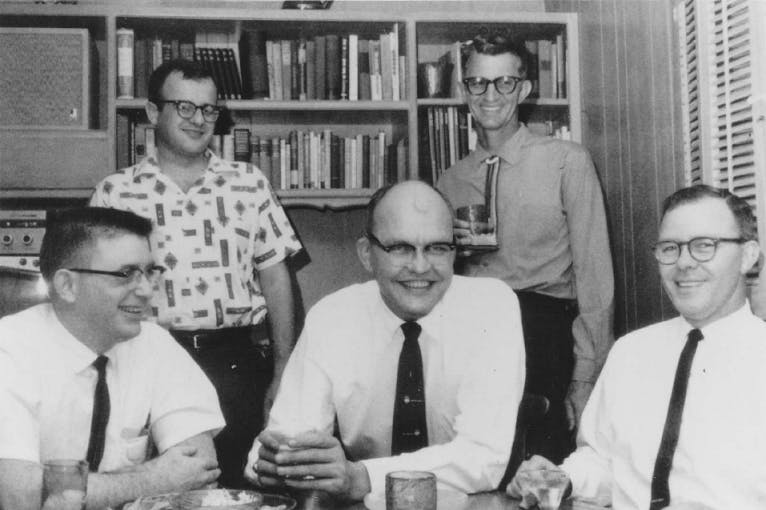
To be fair, it must be added that Jack Kilby was not the only prophet in his land. Parallel to him in California, Robert Noyce (future co-founder of Intel) was working intensely on a similar idea. This led to a long legal battle later known in tech history as the “Great Patent War.”
Two Paths to One Goal. While Kilby created his circuit on germanium, Noyce used silicon and devised a more practical way of connecting elements using metal evaporation. However, it was the Texan resilience and engineering pragmatism of Texas Instruments that allowed Kilby to be the first to prove the bold concept from theory to real, working hardware. In the end, both companies decided not to exhaust themselves in court and simply exchanged licenses.
Genius Without the Hype. Kilby never tried to become a scientific “rock star” or the media face of the Silicon Prairie. He remained a classic Texas professional—restrained, soft-spoken, and focused purely on the result rather than creating artificial hype around his persona.
Nobel Mundanity. When he finally received the well-deserved Nobel Prize in Physics in 2000, his speech lacked grandiose words about changing civilization. Kilby simply noted that back in 1958, he was merely “solving a work task” set before him by difficult circumstances.
This story proves that great inventions often literally hang in the air, and behind them stand not solitary mythical demiurges, but hardworking people who simply do their jobs very well. Kilby didn’t strive to enter history—he just wanted devices to stop breaking because of poor soldering. And it was this professional groundedness that made his revolution real.
A Legacy Without Borders
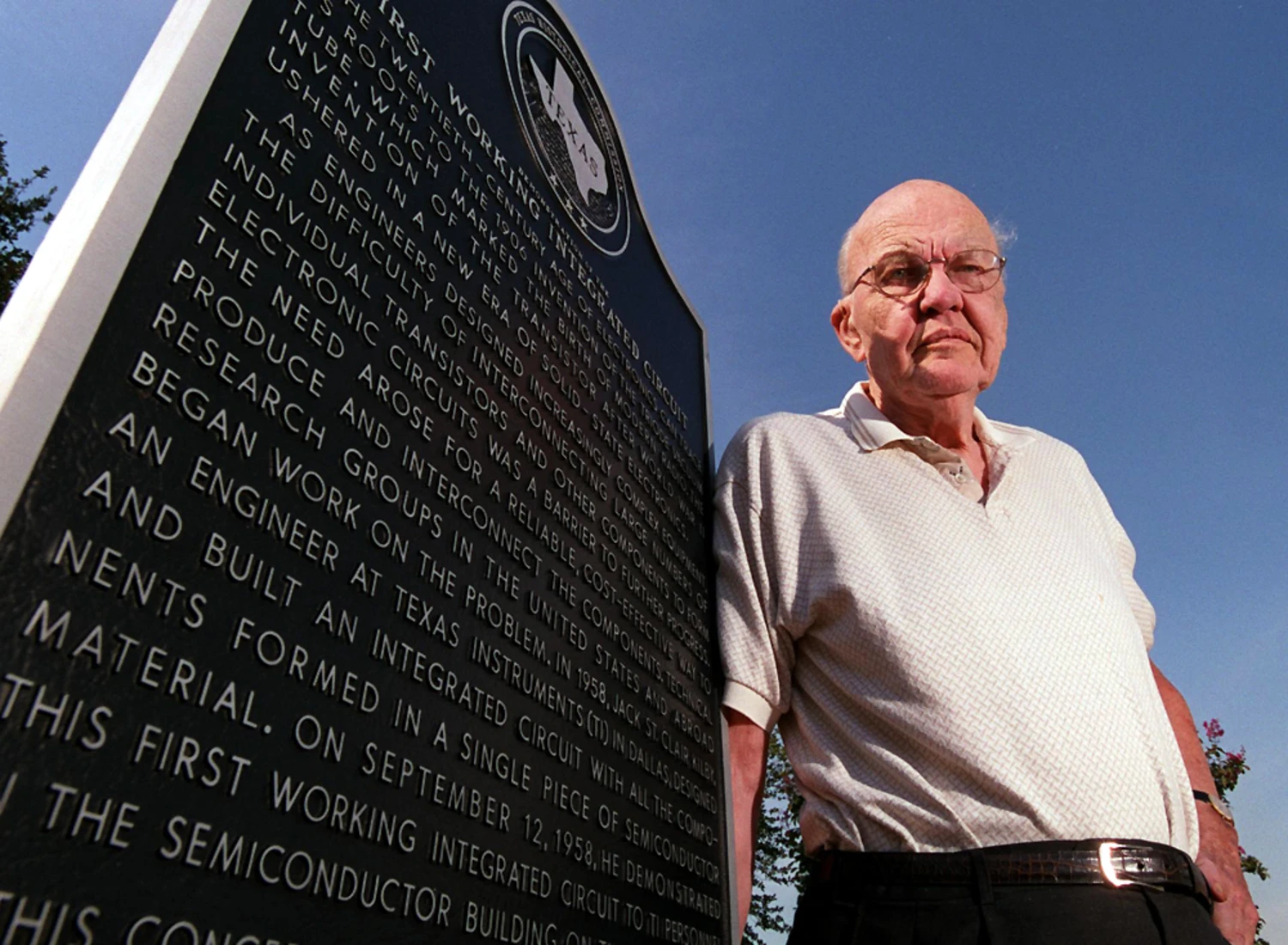
Today, we take digital reality for granted, yet every byte of information and every signal in the network passes through the descendants of that very prototype created by a Texas engineer. Jack Kilby’s legacy became the foundation upon which the architecture of modern life stands. A local innovation turned into a global standard without losing its Texas identity.
- A Global Breakthrough. The microchip traveled the path from top-secret military technology and complex space systems to the “heart” of every smartphone, coffee machine, and electric car. What was once available only to NASA now connects billions of people.
- The Authenticity of Texas Instruments. While tech giants compete in marketing gloss and flashy presentations, Texas Instruments remains the unwavering backbone of the state’s economy.
- The Texas Character. Kilby didn’t disrupt systems with loud proclamations; he simply rewrote the rules of the game for the entire world while sitting at a desk in an empty laboratory.
Sources:
- https://www.thestoryoftexas.com/artifact-stories/jack-kilbys-integrated-circuit/
- https://www.ti.com/about-ti/newsroom/company-blog/from-idea-to-invention-the-origin-story-of-the-tiny-chip-that-changed-the-world.html
- https://www.nbcnews.com/id/wbna8303567
- https://blog.alandotchin.com/jack-kilby-inventor-of-the-integrated-circuit-and-pioneer-of-the-digital-age/
