

The history of great economic miracles rarely begins with loud fanfares or sudden discoveries. More often than not, the driver of tectonic change is an unbearable exhaustion with routine and chaos. It is commonly believed that the modern American megapolises of the South grew solely due to “black gold” or ambitious space programs. However, the true foundation of this global power was laid much earlier, in the stifling atmosphere of agricultural disorder. This is the story of how the idea of continuous motion shattered the old ways, forced cities to change their historical destinies, and quietly accumulated the capital for the era we now call modern.
Below, on houstoname.com, we examine the details of the industry’s birth:
- How an invisible barrier blocked the region’s economic potential and why human hands became the main brake on global progress;
- The non-obvious engineering solution that changed the concept of industrial production long before the arrival of the automotive assembly line;
- How an intellectual epiphany at one point on the map forced another city to urgently transform into a global logistical leviathan;
- Where the financial infrastructure that allowed for the seamless launch of the 20th century’s most famous energy rush actually came from;
- Why the technology that forever changed economic geography remained in the shadow of more publicized historical events.
The “Bottleneck” Problem in the Cotton Industry
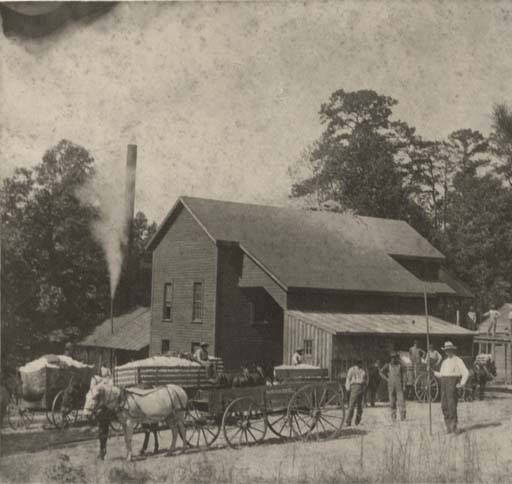
Until the 1880s, the Texas cotton industry resembled a giant with its hands tied. Although the fertile lands of the South produced record harvests, processing technology was stuck in the era of manual labor. The process of “ginning” (separating fiber from seeds) was chaotic, filthy, and catastrophically slow.
Farmers bringing their crops to the mills faced a logistical nightmare. Every stage of the process was separated from the next by physical labor:
- Unloading. Raw materials were unloaded by hand from wagons, shoveled out, or carried in baskets. This took hours while wagons stood in long lines under the scorching Texas sun.
- Transportation. Inside the mill, cotton was carried in sacks to the gins. This created massive clouds of dust, making the work hazardous to the lungs.
- Packaging. After the seeds were removed, the finished cotton was again manually gathered and carried to the press to form bales.
This was the ultimate bottleneck: the capacity of the fields was higher than the mills’ ability to process the harvest. If one link broke or a person grew tired, the entire cycle ground to a halt.
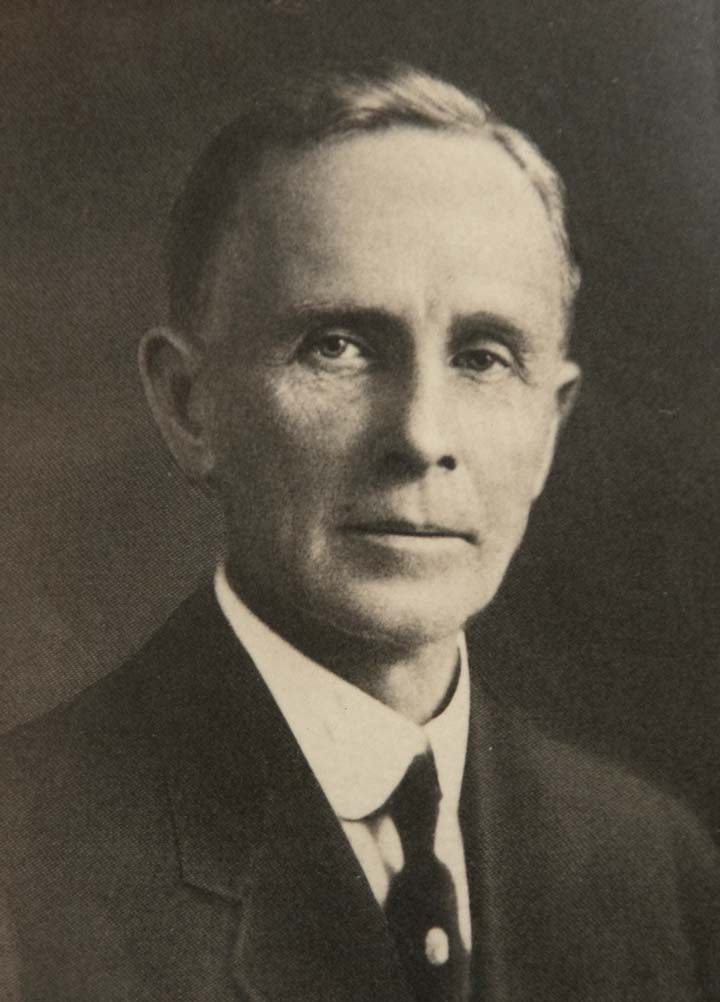
Robert Munger: Shifting from a “Set of Machines” to a System
Robert Munger, a Texas native who owned a small factory in Rosebud, realized that the problem wasn’t that the gins worked slowly, but that they weren’t connected. In 1884, he proposed an idea that became the Southern equivalent of Henry Ford’s assembly line—System Ginning.
Munger decided to replace baskets and muscle power with pneumatics. His system functioned as a single mechanized organism:
- Pneumatic Elevator. Instead of manual unloading, Munger used large vacuum-like pipes. They sucked the cotton directly from the farmer’s wagon and transferred it into the building.
- Continuous Flow. Air currents carried the cotton through cleaners directly to a battery of gins. Not a single person touched the raw material during this stage.
- Automatic Packaging. The cleaned fiber was automatically fed into the press.
The Texas Scale: The Result of a Revolution
Munger’s invention didn’t just speed up the work—it changed the economic geography of Texas.
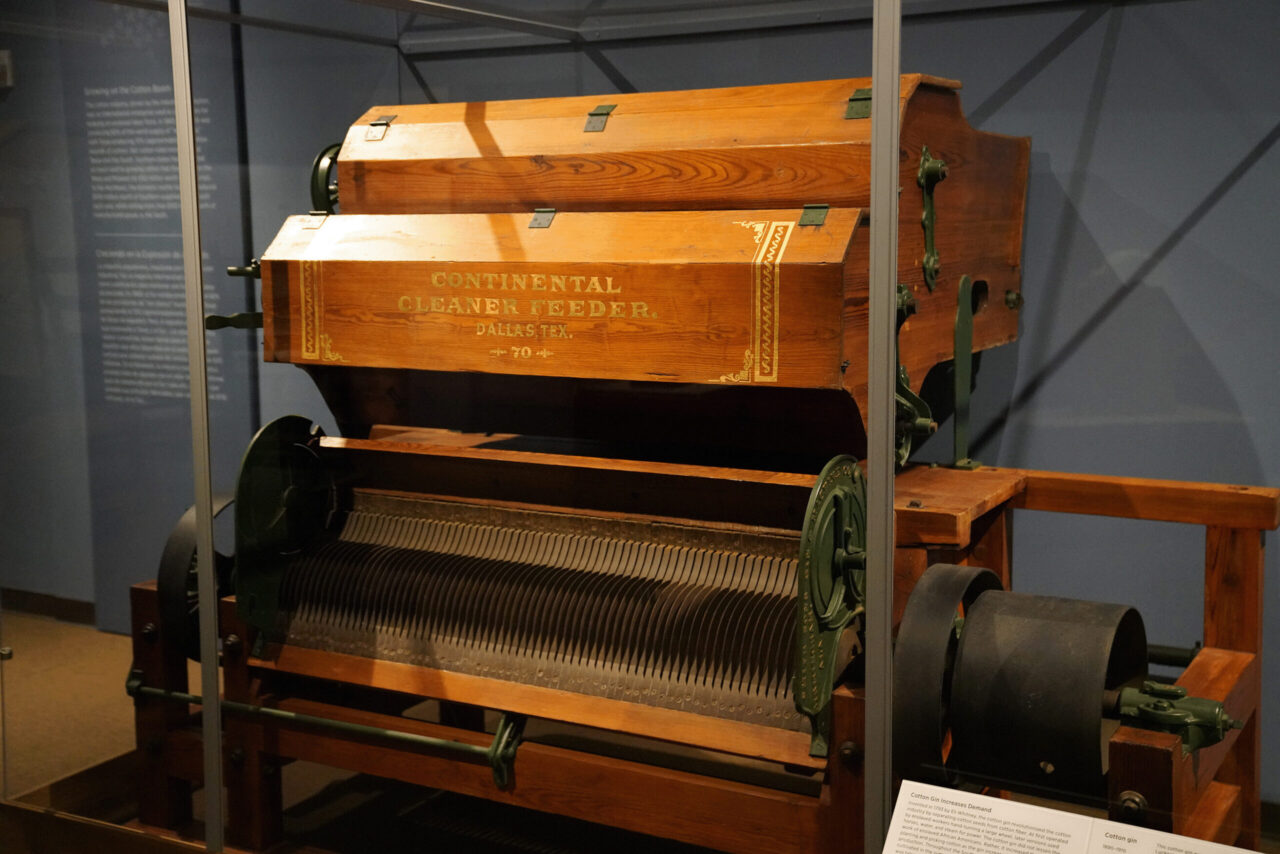
The Birth of Industrial Dallas. To manufacture his systems, Munger moved his business to Dallas. This turned the city into the world capital of cotton equipment manufacturing. Munger’s Continental Gin Company became the largest enterprise of its kind in the world.
Cleanliness and Safety. Because the cotton moved through enclosed pipes, dust levels plummeted, saving the health of thousands of workers.
Economic Explosion. A single Munger mill could process as much cotton as five or six traditional mills previously could, while using one-third of the personnel.
Houston: A Port Brought to Life by Machines
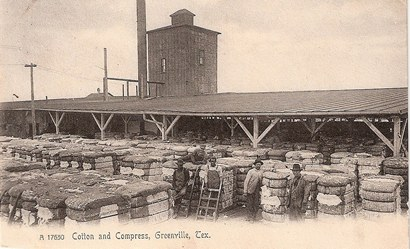
While Robert Munger founded his revolutionary Munger Improved Cotton Gin Company in Dallas, Houston became the primary geographical and financial beneficiary of his inventions. An ideal Texas tandem was formed: Dallas provided the engineering “brains” for automation, while Houston provided the “muscle” and access to the global ocean.
Once mills across Texas switched to the continuous cycle of “system ginning,” Houston transformed into a massive logistical hub.
- Speed Dictating the Rules. Plantations could now ship cotton for cleaning instantly, without the fear of getting stuck at the unloading stage.
- Traffic Collapse Spawning Progress. Enormous volumes of fiber flooded into Houston, forcing the city to rapidly develop its rail network. Houston became the place “where 17 railroads meet.”
- Around-the-Clock Conveyor. Mills filled railcars and ship hulls destined for the textile capitals of Europe—Manchester and Lille.
This sudden influx of “White Gold” did more than just clog the rails; it built the financial fortress that would eventually house the global energy industry. The cotton brokers and shipping magnates of Houston didn’t just hoard their profits; they established the banks, the deep-water channels, and the commercial networks that made the city ready for the 1901 Spindletop discovery. Without the mechanical efficiency of Munger’s machines clearing the logistical “bottleneck,” the capital required to jumpstart the Texas oil boom might have remained locked in the mud of unpicked, unprocessed fields.
Ultimately, the Munger era solidified a distinct Texan archetype: the marriage of academic engineering and raw industrial ambition. It proved that the state’s true power wasn’t just in its soil, but in its ability to synchronize the “brains” of the Dallas prairie with the “water” of the Houston coast. This blueprint—automating a process to its breaking point and then building a world-class city to handle the output—became the DNA of the Texas economy, paving the way for everything from NASA’s mission control to the modern technological corridor.
The Foundation for the Oil Era
The most significant and often ignored fact is that “cotton money” built modern Houston. Cotton brokers and logistical titans amassed million-dollar fortunes thanks to Munger’s inventions.
When the first massive oil gusher erupted at Spindletop in 1901, Houston’s financial infrastructure was already in place. Local bankers and investors, enriched by “white gold,” had enough courage and liquid capital to begin pouring money into oil.
Cotton Processing Comparison: Before and After Munger
| Process | Before Munger (Manual Labor) | Munger System (Automation) |
| Wagon Unloading | 1-2 hours of heavy labor | 10-15 minutes (Pneumatic) |
| Fire Risk | Extremely High | Minimal (Enclosed System) |
| Fiber Quality | Uneven (due to debris) | High (Automatic Cleaning) |
| Staffing | Army of laborers needed | A few machine operators |
| Throughput | Limited by physical strength | Streamlined, Industrial |
Texas stopped being a mere raw-material appendage precisely because it learned to convert its agrarian power into high-tech infrastructure. Today, the state doesn’t just export goods—it exports standards.
