

In the early 1960s, while the entire world was captivated by humanity’s first steps in the space race, another group of researchers was attempting an equally ambitious breakthrough in the opposite direction. Scientists aimed to pierce the Earth’s crust and reach our planet’s mantle. This massive scientific initiative was named Project Mohole. The details of this daring project are covered on houstoname.com.
Breaking Through to the Planet’s Core: Why American Scientists Decided to Drill into the Ocean Floor
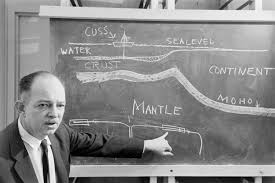
The idea of peering deep into our planet to unlock its ancient geological secrets did not emerge out of nowhere. The world’s leading geophysicists wanted more than just theoretical calculations of the subsurface; they sought to witness and directly analyze the Mohorovičić discontinuity. This mysterious underground layer is a fundamental planetary boundary separating the solid crust from the scorching upper mantle.
Instead of rocky land, scientists chose the ocean depths for their assault, where the lithosphere is significantly thinner. Although the ambitious ultra-deep well never reached its final destination, the experiment permanently altered offshore drilling technologies, laying the groundwork for modern oceanography and offshore mineral extraction.
Andriy Mokhorovych’s Seismic Puzzle
This unique transition zone was named in honor of the prominent Croatian scientist Andrija Mohorovičić. In 1909, while analyzing the aftermath of a powerful Balkan earthquake, he made a sensational discovery that overturned contemporary concepts of the planet’s internal structure.
The scientist’s research relied on several crucial geophysical facts:
- Sudden Speed Change: Seismic waves from tremors abruptly and sharply increased their velocity when passing through this boundary.
- Density Variance: This wave dynamics clearly indicated a transition from less dense crustal rocks to the significantly denser and stronger material of the mantle.
- Geological Barrier: The boundary was a global divider encircling the entire globe, varying only in its depth.
- Key to Planetary Evolution: Obtaining direct samples of this rock would offer insights into exactly how the Earth formed billions of years ago.
The Oceanic Strategy of the AMSOC Society
Organizing an expedition to this subsurface boundary faced severe geographical hurdles. Since the thickness of the outer solid layer on continents is massive, reaching lengths of 30 to 50 kilometers, drilling an ultra-deep well on land would require colossal financial investments and decades of continuous labor.
In the ocean, however, beneath a vast expanse of water, the Earth’s crust is much thinner, measuring just 5 to 10 kilometers in some areas. That is why an informal but highly influential association of leading American scientists, eccentrically named the American Miscellaneous Society (AMSOC), proposed an ambitious and daring plan to the US government: drill into the bottom of the Pacific Ocean at a location where the underground boundary lies closest to the surface.
The Dawn of the Underwater Race
This initiative triggered a massive scientific rivalry that practically matched the conquest of space in both complexity and financial cost. Scientists fully understood that drilling several kilometers beneath the water would require the creation of entirely new technologies and unique floating platforms.
Ultimately, the AMSOC project proved to the global community that exploring the seafloor was the only realistic and economically justified path to studying the mantle. The bold idea of American geophysicists opened a new era in marine geology, forcing engineers to seek unconventional solutions for operating under colossal water pressure and unstable oceanic conditions to achieve the primary scientific goal of the 20th century.
The Houston Technological Staging Ground
Once the concept was approved at the highest government level, a logical question arose: who could build the tools for such an experiment? The organizers immediately turned their attention to Texas, specifically to Houston, which had already earned the status of the world capital of oil equipment manufacturing. Local enterprises possessed unique expertise in manufacturing ultra-strong drill bits and heavy industrial machinery.
A consortium of Houston businesses, including the legendary Hughes Tool Company, established specialized research laboratories. Engineers set out to design equipment capable of enduring unprecedented loads. It was within the facilities of America’s Oil Horse where unique diamond drill bits and experimental drill strings were engineered to pass through kilometers of water and ultra-hard rock.
An Engineering Challenge in the Open Ocean
Realizing this vision required entirely new navigation methods, as no one in the world had attempted to operate at depths of several kilometers at the time. The main obstacle was the instability of the vessel: marine currents and continuous waves inevitably shifted the barge, threatening an instant rupture of the ultra-long steel pipe string.
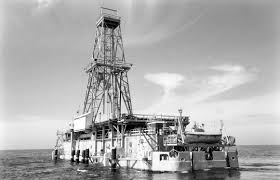
To solve this complex problem, specialists modernized the self-propelled vessel CUSS I. Houston designers proposed integrating several revolutionary innovations:
- Dynamic Positioning: Four powerful thrusters were installed around the hull to keep the ship fixed over the work point without using traditional anchors.
- Radar Stabilization: The platform’s position was calculated automatically based on signals from underwater acoustic buoys anchored to the seafloor.
- Flexible Couplings: Pipe joints were selected so that the structure could withstand natural bending during storms.
The First Samples from Mysterious Depths
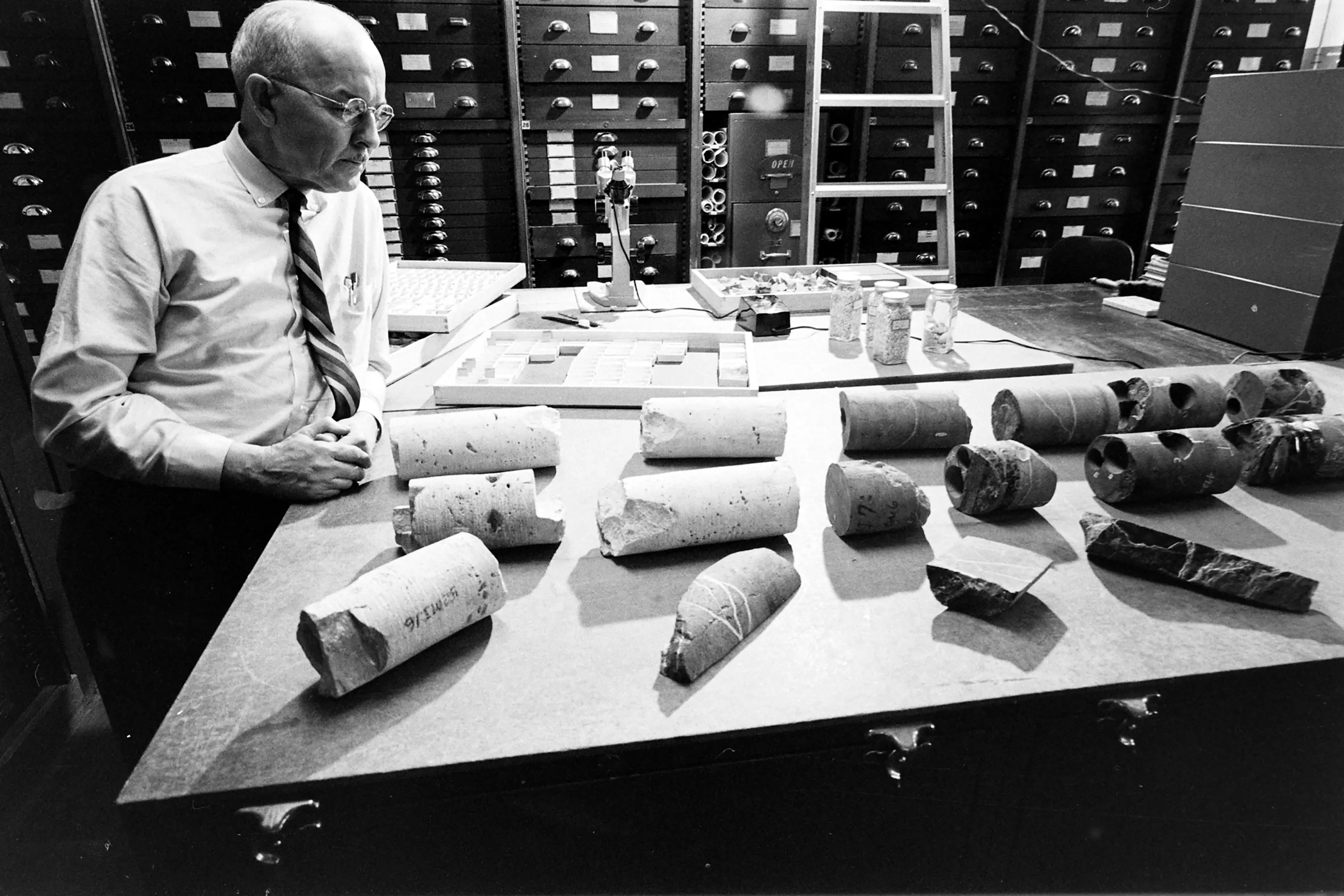
In the spring of 1961, near the Mexican island of Guadalupe, the first practical phase of the experiment commenced. The modernized vessel successfully lowered tools through three and a half kilometers of ocean water and penetrated an additional 183 meters into the seafloor sediments. When the retrieved core sample was cut open, scientists obtained unique specimens of pure basalt from the Upper Miocene epoch.
This moment was a true triumph for global geology. The extracted rocks contained unique fossils of ancient microorganisms, allowing scientists to determine the age of ocean basins with greater accuracy. The experiment clearly demonstrated that deep-sea scientific research is technically feasible even under harsh weather conditions in the open sea.
The Bureaucratic Labyrinths of Washington
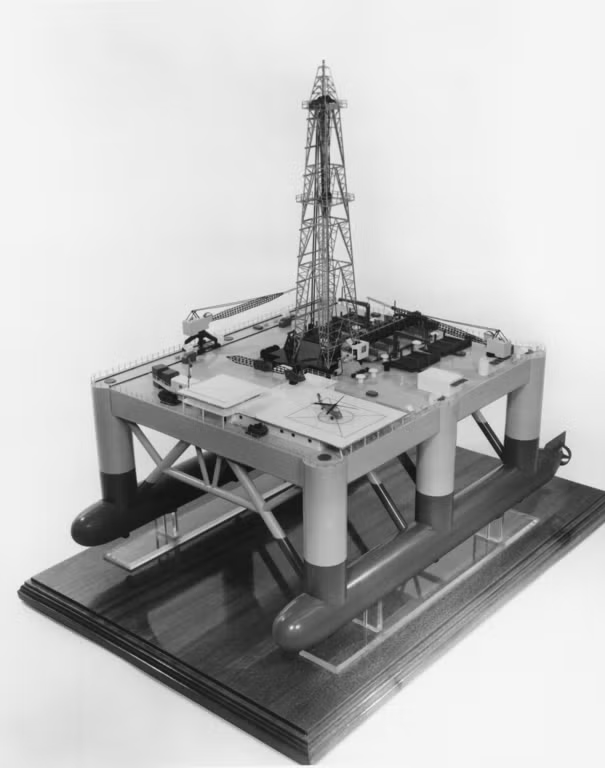
Following the stunning initial success, the initiators of the ambitious project planned to begin the second phase immediately, which involved constructing a much larger and more technologically advanced drilling platform. However, serious bureaucratic obstacles emerged along this path, turning a scientific breakthrough into a prolonged political standoff. The US National Science Foundation unexpectedly awarded the prime contract to a major Houston defense company, Brown & Root. This enterprise wielded substantial political influence in Washington and maintained close ties with the state’s top leadership, but it completely lacked sufficient experience in conducting purely geological research at great depths.
Due to inefficient management, the new contractor’s lack of specialized expertise, and continuous disputes between scientists and managers, engineering development costs began to skyrocket. The project lost its original flexible format and became bogged down in approvals.
The financial transformation of Project Mohole occurred under the influence of several destructive factors:
- Budget Bloating: Design and equipment procurement costs multiplied several times over compared to the original financial plan.
- Loss of Scientific Control: Key geophysicists from the AMSOC society were effectively excluded from making strategic technical decisions.
- Shift in Contractor Priorities: The defense company viewed deep-sea drilling merely as one of many secondary government contracts.
- Congressional Investigations: Constant audits by American lawmakers attempting to determine the reasons behind the inefficient use of taxpayer funds.
In 1966, the situation reached its critical peak. Amid massive US budget allocations for fighting the protracted war in Vietnam, as well as colossal expenditures on the Apollo moon program, which held absolute ideological priority, the government was forced to downsize other scientific fields.
The US Congress officially and permanently terminated funding for Project Mohole, declaring it too expensive and risky for the state during a geopolitical crisis.
A Scientific Legacy: From Geology to Modern Platforms
The cancellation of Project Mohole was a severe blow to American science at the time, yet this financial collapse left behind an invaluable legacy. Although the primary geographical target—the Mohorovičić discontinuity—remained unreached, the project’s engineering developments did not vanish. They formed the bedrock for subsequent successful international deep-sea drilling programs conducted without excessive political pressure.
Even though the drill bit never reached the mantle, the project did not waste state resources. The technological developments from this experiment laid a solid foundation for future international research initiatives. Many methods devised by engineers to keep the CUSS I vessel stable were later fully adopted by commercial energy giants.
Today, every modern semi-submersible platform extracting resources on the deep-water shelves of the Gulf of Mexico or the North Sea utilizes dynamic positioning principles originally developed in Texas. The rock samples collected during the experiment helped confirm the theory of plate tectonics, which now serves as the foundation of all planetary science. This daring assault on the Earth’s interior opened humanity’s eyes to the structural design of our underwater world.
Sources:
- https://www.vox.com/unexplainable/22276597/project-mohole-deep-ocean-drilling-unexplainable-podcast
- https://www.earthmagazine.org/article/benchmarks-march-1961-project-mohole-undertakes-first-deep-ocean-drilling/
- https://www.popularmechanics.com/science/environment/a43418443/project-mohole-drilling-project/
