

The vision of colonizing the Moon and Mars has long run up against a harsh economic and physical barrier: payload mass. Transporting a single kilogram of construction material to the lunar surface costs tens of thousands of dollars—and ferrying it to Mars is even more expensive. Hauling concrete blocks or steel structures from Earth to build fully functional outposts is a logistical dead end.
Yet right in Houston—the historical and technological epicenter of American space exploration—a new paradigm is emerging to solve this challenge. Bringing together the resources of NASA’s Lyndon B. Johnson Space Center and pioneering Texas innovators, this collaboration is forging an entirely new field: In-Situ Resource Utilization (ISRU). The cornerstone of this approach is 3D printing engineered for microgravity and extraterrestrial regolith. Discover the details of this ambitious project below on houstoname.com.
Houston as the Epicenter of Space Architecture
Houston earned its unofficial moniker, Space City, back in the 1960s during the triumph of the Apollo program. Today, it serves as a central hub for the ambitious lunar initiative Artemis. Over recent years, however, the city’s role has expanded dramatically. Moving far beyond its classic identity as home to Mission Control, Houston has evolved into the world’s foremost testing ground and research hub for off-planet construction.
A powerful innovation triangle has formed within the unique Texas aerospace ecosystem:
- NASA Johnson Space Center. The center’s state-of-the-art laboratories engineer high-fidelity lunar and Martian regolith simulants, test autonomous robotic systems, and establish rigorous safety benchmarks for future habitat modules.
- Private Aerospace Companies. Regional tech innovators and startups—including NASA partner Intuitive Machines and Texas-based large-scale 3D-printing pioneer ICON—are turning theoretical concepts into operational robotic systems and physical structures.
- Academic and Research Institutions. Houston’s premier research universities, such as Rice University and the University of Houston, are training top-tier talent and designing architectural blueprints for extreme environments.
This closed-loop research and development pipeline has positioned Houston as the proving ground for humanity’s future beyond Earth. Here, space architecture has shifted from science fiction and artistic futurism into a rigorous, practical engineering discipline.
Fueled by the synergy of NASA grants, private venture capital, and deep academic expertise, the city is defining new standards for building on the Moon and Mars. Moreover, lessons learned from developing autonomous systems and utilizing in-situ resources in space are already being deployed on Earth to create ultra-resilient, sustainable architecture.
Building Future Habitats Beyond Earth
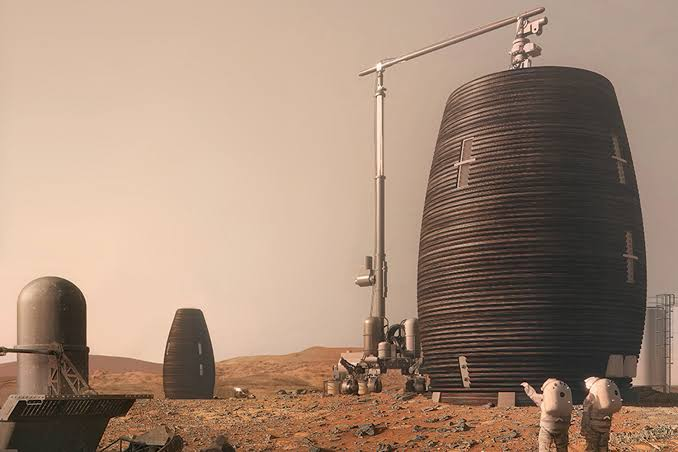
The core concept championed by Houston engineers and researchers is a fundamental shift away from hauling Earth-based binding agents, such as water or conventional cement. Instead, the focus is squarely on in-situ resource utilization via thermal sintering or thermoplastic binding of lunar regolith.
Project Olympus: 3D-Printing a New Frontier
Among the most ambitious initiatives under development—funded through NASA’s Small Business Innovation Research (SBIR) program and developed in close collaboration with experts at Johnson Space Center—is Project Olympus. It envisions deploying a large-scale 3D printer to the lunar surface as part of upcoming Artemis missions.
- Sintering Technology. The robotic system utilizes high-energy lasers or microwave radiation to fuse fine grains of lunar regolith into an ultra-durable ceramic-like structure without requiring liquid water.
- Total Autonomy. The modular platform is designed to deploy on the lunar surface without direct human intervention, autonomously scanning and mapping terrain to erect protective barriers well before a crewed mission touches down.
Microgravity Printing: Testing on the ISS
Before erecting full-scale structures on other celestial bodies, Houston engineers thoroughly validated additive manufacturing techniques in zero gravity directly aboard the International Space Station.
- Made In Space. Managed directly from Mission Control in Houston, these orbital manufacturing trials proved that 3D printing in microgravity can yield precision replacement parts, tools, and structural elements without material sagging or deforming under Earth’s gravitational pull.
- Metal 3D Printing. The subsequent phase explored additive manufacturing with high-strength metal alloys in vacuum and microgravity conditions. This breakthrough opens the door to rapid in-situ repairs of space station hulls and interplanetary spacecraft directly in open space.
These breakthroughs prove that space exploration will no longer depend on a continuous supply chain from Earth for every individual component. Shifting toward on-orbit manufacturing and utilizing lunar soil radically alters the economics of space missions, laying the groundwork for a sustained, self-sufficient human presence beyond Earth.
In doing so, Houston firmly cements its status not merely as a flight operations command center, but as the premier technological workshop and powerhouse for the next era of solar system exploration.
A Home Beyond Earth: What and How We Will Build on the Moon and Mars
Off-world architecture fundamentally differs from terrestrial building practices. Its greatest adversaries are relentless cosmic radiation, extreme thermal swings (ranging from +120°C to -130°C on the Moon), absolute vacuum, and hazardous micrometeoroid bombardments.
Houston developers and NASA engineers break down the construction of extraterrestrial infrastructure into three sequential phases:
- Phase 1: Primary Infrastructure. The first structures printed on the Moon will not be crew quarters, but landing pads and protective roadways. During a spacecraft touchdown, rocket plume exhaust propels fine, abrasive lunar regolith at supersonic velocities, risking severe damage to surrounding hardware. Robotic 3D printing creates sintered, hardened surfaces and blast-deflection berms to mitigate this threat.
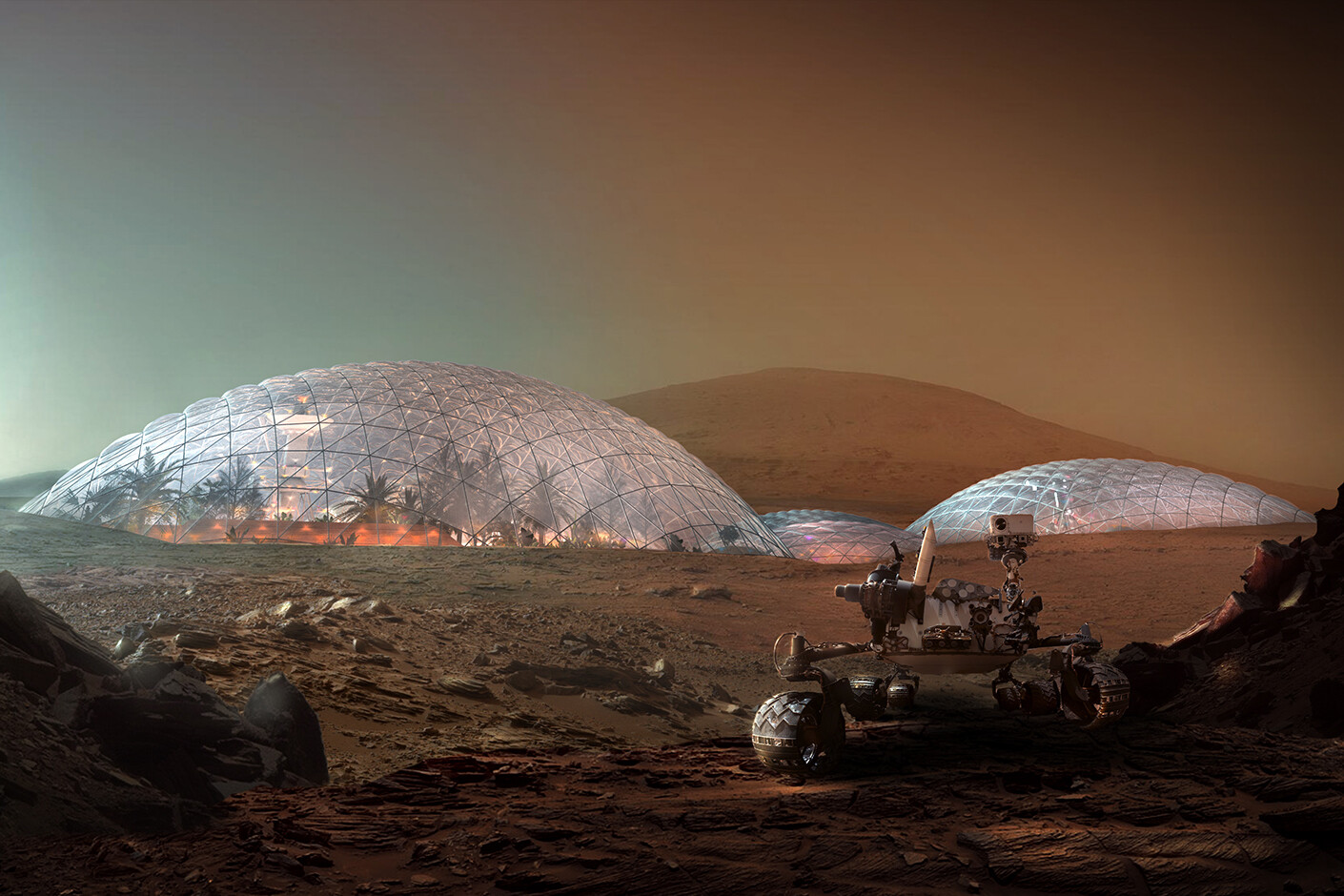
- Phase 2: Protective Shells and Shades. Because lunar soil is an outstanding natural thermal insulator and radiation shield, printers will construct thick-walled protective outer shells over inflatable habitat modules delivered from Earth. The printed canopy absorbs solar flares, radiation, and micrometeorites, sheltering the pressurized living quarters and life-support systems inside.
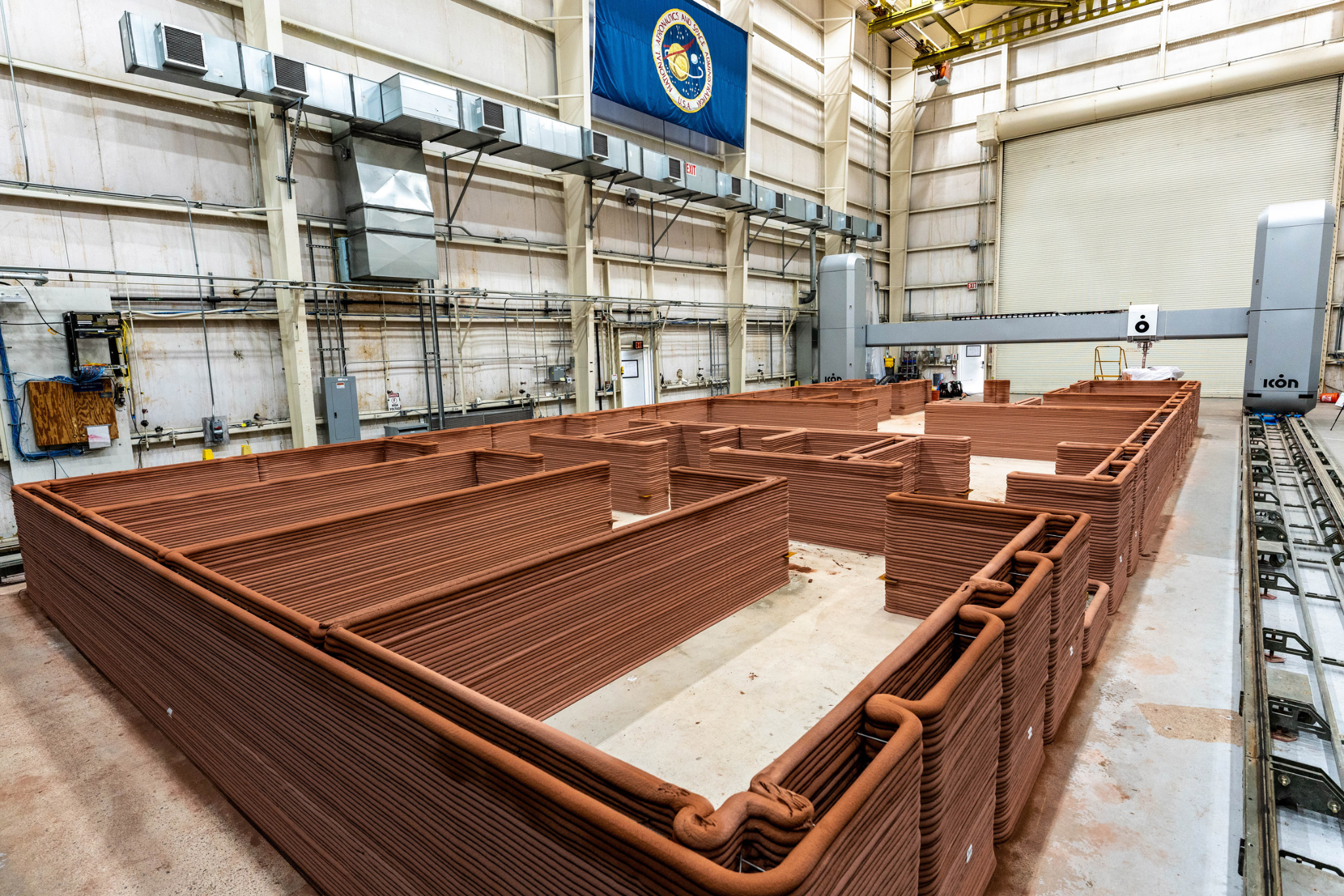
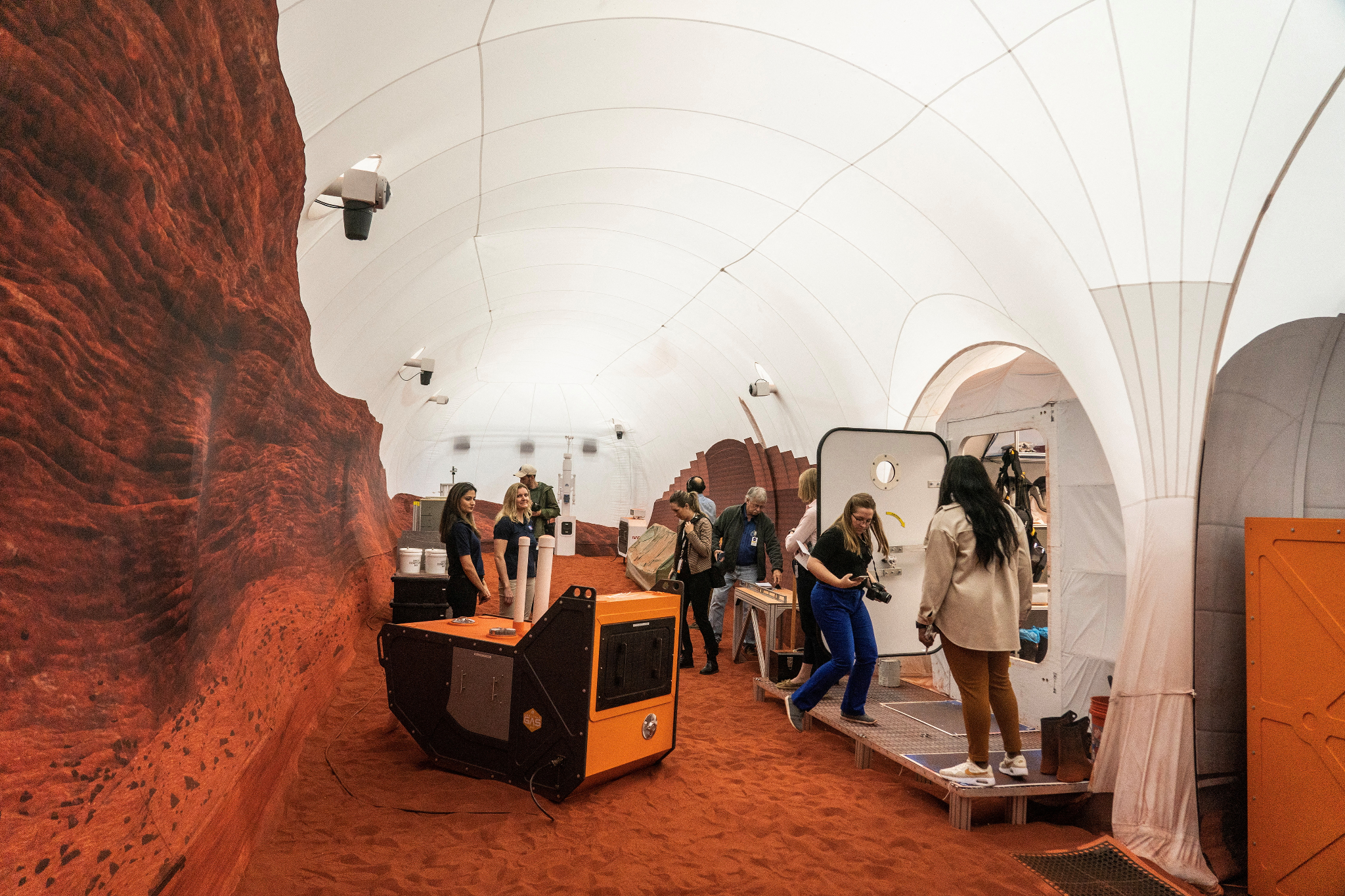
- Phase 3: Fully Printed Autonomous Bases. A prime example of simulated Martian habitats is Mars Dune Alpha, built by ICON directly at NASA Johnson Space Center in Houston. Spanning 158 m² (1,700 sq ft), the structure was 3D-printed using ICON’s proprietary high-strength material, Lavacrete. Inside this habitat, NASA conducts year-long CHAPEA analog missions, where test crews live in total isolation for 378 days to simulate the reality and autonomy of living on Mars.
This three-phase strategy demonstrates that off-world exploration begins not with soaring futuristic skyscrapers, but with pragmatic engineering and defensive shielding. Automated systems must first establish a secure industrial and logistical foundation before long-duration human habitation can thrive.
The Mars Dune Alpha project has proven that additive construction can deliver ergonomic, durable living environments even under extreme conditions. Lessons learned from Houston’s analog missions are already serving as the foundational blueprints for humanity’s first permanent settlements on the Moon and Mars.
Comparing Approaches: Terrestrial Construction vs. Off-World 3D Printing
| Parameter | Terrestrial Construction | Off-World 3D Printing (Houston Approach) |
| Primary Materials | Concrete, steel, brick, timber | In-situ regolith, basalt fibers, polymers |
| Binding Agents | Water, cement mortar | Laser sintering, thermoplastics, melting |
| Workforce | Construction crews, heavy machinery | Fully autonomous swarms of robotic printers |
| Primary Objective | Weatherproofing (rain, wind), aesthetic design | Radiation shielding, vacuum seal, micrometeorite defense, thermal insulation |
| Material Logistics | Local supply chains | ISRU — 90%+ of materials sourced on-site |
Impact on Earth: How Space Tech Is Reshaping Houston and the World
Technologies pioneered in Houston for lunar and Martian exploration are already creating powerful spin-offs for terrestrial construction and civil infrastructure.
- Sustainable and Ultra-Resilient Construction. Innovative 3D-printing techniques that eliminate the need for fresh water and dramatically lower carbon emissions are already being deployed to build affordable housing quickly. Furthermore, these monolithic structures offer superior resistance to hurricanes and tornadoes—a vital advantage along the Texas Gulf Coast.
- Autonomous Robotics. Algorithms designed for autonomous navigation and printer operation during harsh lunar nights are being integrated into terrestrial robotic systems. These robots assist in emergency disaster response and construction in high-risk environments.
- Economic Growth for the Region. Houston is solidifying its role as a preeminent global capital of the New Space economy—a high-tech sector uniting NASA’s foundational science with the agility and capital of private venture enterprise.
This dynamic feedback loop between space exploration and terrestrial needs underscores the true value of aerospace investment. The quest to engineer safe habitats on distant worlds is unlocking materials and methodologies that make housing on Earth more accessible, resilient, and eco-friendly.
As a result, Houston is doing more than preserving its storied legacy as the heart of American spaceflight—it is transforming into a global laboratory for the future. The work of Texas engineers demonstrates that the path to exploring the stars begins by solving our home planet’s most pressing technological and environmental challenges.
